New Products: Smoothies by Bioingred®
Choosing a natural ingredient for a cosmetic formulation no longer depends solely on whether its name looks appealing on the label. Increasingly, innovation teams need to answer much more specific questions: What does it do in the formula? What result can it demonstrate? What type of hair or skin does it make sense for? How is it incorporated, and what product story can be built around it?
This shift is transforming hair care in particular. Heat protection, repair treatments, and scalp care are gaining prominence, while the so-called skinification of hair care is leading consumers to expect more specialized products with recognizable ingredients and substantiated benefits. In 2025, premium hair care grew by 4% in the United States, while categories such as styling, scalp care, and heat protection stood out in market performance.
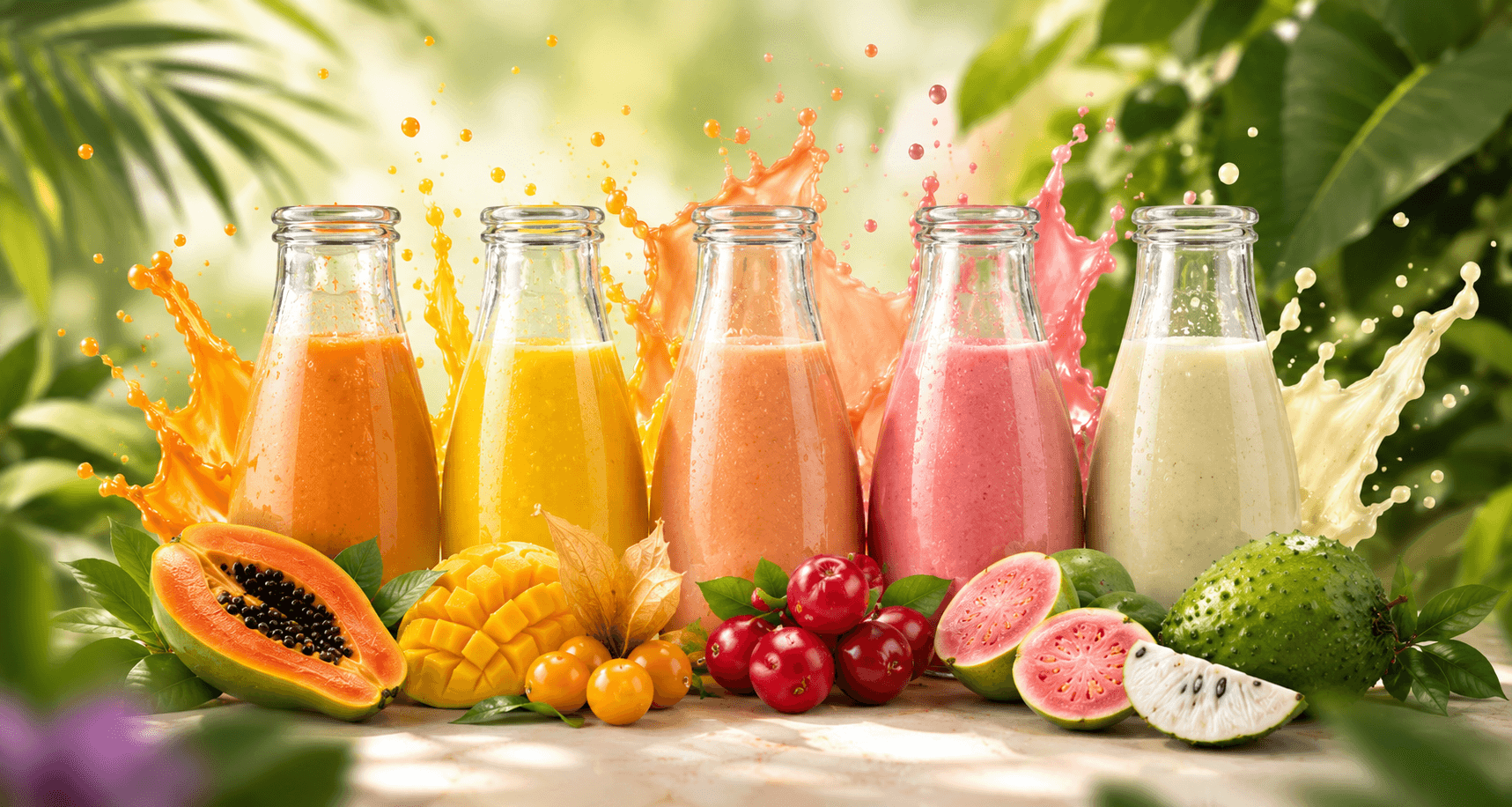
Against this backdrop, the new Smoothies by Bioingred® were created: a line of fruit-derived bioactives developed from species associated with Colombian biodiversity and designed to transform familiar fruits into practical tools for cosmetic innovation.
From a Natural Ingredient to an Ingredient with Purpose
The industry is moving away from a mindset focused on “repairing after damage” toward a broader vision of overall hair fiber health: reducing the impact of heat and mechanical stress, improving strength, caring for the scalp, and maintaining sensory attributes such as softness and manageability.
This evolution opens an important opportunity for brands. A product no longer needs to communicate only “hydration” or “repair.” It can be built around more specific needs: hair frequently exposed to flat irons and blow dryers, bleached fibers with high friction, fine hair prone to breakage, compromised scalp conditions, or curly-hair routines that require conditioning without sacrificing movement.
This trend also has a technical dimension. Research on hair fibers has shown that heat exposure can cause structural changes in both the cuticle and keratin. Techniques such as microscopy, DSC, and Raman spectroscopy can be used to assess this damage and analyze the ability of cosmetic treatments to help protect the hair structure.
For a formulator, therefore, the value of an ingredient becomes much more compelling when it can move from:
“contains a recognizable fruit” to: “this fruit was transformed into an ingredient whose performance was evaluated against a specific need.”
That is where our Smoothies come in.
What Are Smoothies?
Smoothies are microstructured functional actives developed from fruits, designed to preserve their identity while transforming it into cosmetic performance.
The technology makes it possible to work with the fruit matrix to obtain ingredients that combine naturally occurring fruit components with a structure suitable for cosmetic applications. This creates a particularly interesting proposition for brands seeking to combine biodiversity, naturality, sensoriality, and efficacy evidence within the same concept.
But the true differentiation of the line becomes clear when each ingredient is considered individually.
Not every fruit is intended to address the same need.
Five Fruits. Five Different Routes to Innovation.
The results presented below correspond to specific evidence obtained with Bioingred Smoothie ingredients and should not be interpreted as a general extrapolation of the properties described in the literature for each fruit.
Smoothie Camu-camu: Strength for Highly Stressed Hair Fibers
Bleaching, chemical processing, and repeated styling can increase fiber fragility and friction. For this type of hair, speaking only about “nourishment” may be too generic: the real need is to improve mechanical behavior.
Smoothie Camu-camu showed +38.7% resistance to breakage, +33.3% mechanical stability of the hair fiber, and a 60% reduction in friction on dry hair. It also showed +18% conditioning on wet hair.
What does this mean for a formulation?
Lower friction facilitates movement between fibers and may contribute to a perception of greater softness and manageability. When combined with mechanical strength results, this opens a particularly attractive territory for severely bleached, fine, or weakened hair.
Product opportunity: reconstruction mask for bleached hair, strengthening conditioner, or post-color treatment focused on strength and softness.
The communication territory does not need to be simply “with camu-camu,” but something more relevant to consumers:
strength against mechanical stress + reduced friction + improved manageability.
Smoothie Uchuva: A Natural Route Toward Heat Protection
Flat irons, blow dryers, and curling irons are part of many everyday hair-care routines. The challenge arises when repeated heat exposure begins to compromise the structure of the fiber.
This is where uchuva opens a different territory.
Smoothie Uchuva showed +28% protection against thermal damage, reduced surface friction on dry hair, and +10% resistance to breakage in an ex vivo model involving 8,000 passes. The tests included evaluation of α-keratin behavior following thermal exposure at 230 °C.
The commercial translation is clear: this is not simply about adding an Andean fruit to a hair treatment. It is about developing a product for consumers who regularly use heat-styling tools and want to preserve softness, strength, and improved fiber behavior after styling.
Product opportunity: pre-styling leave-in, heat-protective styling cream, pre-blow-dry hair serum, or mask for hair regularly exposed to heat.
This positioning aligns with one of the most visible movements in the market. Products focused on protection against heat, UV radiation, pollution, and mechanical stress are part of the transition toward preventive hair-fiber care.
Smoothie Guayaba: When Strengthening Means Measuring Breakage
Fine or weakened hair does not always need a heavy formula. Often, it needs to improve its ability to withstand the everyday stress caused by brushing, detangling, and environmental factors.
In specific tests, Smoothie Guayaba showed +36.4% resistance to breakage, +29.3% mechanical stability, and 11.6% fewer broken fibers after combing.
This makes it possible to build a much more precise argument around the concept of strengthening.
Data: fewer fibers break during the test.
Interpretation: the hair withstands mechanical stress more effectively.
Communication territory: hair that is more resistant to everyday styling.
Product opportunity: strengthening shampoo for fine hair, anti-breakage conditioner, daily treatment, or a line designed for hair exposed to sun, wind, chlorine, and salt water.
For marketing, guava also adds a particularly powerful element: a fruit that consumers recognize and that can be linked to a measurable functional benefit, preventing natural storytelling from becoming disconnected from performance.
Smoothie Papaya: A Bridge Between Hair Care, Scalp Care, and Skin Care
Papaya is probably the most versatile ingredient in the launch because its evidence supports exploration across several territories.
On skin, it showed +75.7% removal of dead skin cells, a 10.2% reduction in transepidermal water loss —TEWL—, and a 21.9% increase in S. hominis in the microbiome analyses conducted. On hair, it showed +37.2% resistance to breakage, +29.2% softness on dry hair, and +18% conditioning on wet hair.
TEWL is an indicator used to assess how efficiently the skin barrier prevents water loss. A reduction following a controlled disruption of the barrier is therefore particularly interesting for concepts focused on recovery and maintenance of barrier function.
These results open several possibilities.
In skin care, it can be explored in formulations focused on exfoliation and gentle skin renewal.
In scalp care, it enables concepts that combine cleansing, barrier care, and scalp balance.
In hair care, strength, softness, and conditioning create a natural fit with curly and wavy hair, where detangling and wet-fiber manageability are particularly relevant.
Product opportunities: renewing serum, pre-shampoo scalp treatment, curl mask, strengthening conditioner, or scalp-care product focused on cleansing and comfort.
Papaya also demonstrates something important for innovation: the same species can open opportunities across different categories when the conversation is built around specific evidence rather than only traditional associations with the fruit.
Smoothie Guanábana: Protection for Hair Exposed to Heat and Styling
Guanábana enters a territory similar to Uchuva, but offers brands a different fruit narrative for developing products intended for fibers exposed to heat and mechanical stress.
Evaluations report approximately +30% thermal protection, reduced friction on dry hair, +17% resistance to breakage in an ex vivo model, and +22% conditioning on wet hair, with thermal-exposure testing conducted at temperatures of up to 230 °C.
For the formulator, this creates an interesting combination: protection + strength + conditioning.
For marketing, it can become a “rescue for stressed hair” concept, aimed at consumers whose hair loses softness and manageability after blow-drying or frequent use of heat-styling tools.
Product opportunity: protective shampoo, post-styling conditioner, heat-protective mask, or leave-in treatment designed to reduce the perception of fragility.
From Evidence to Concept: What Could a Brand Develop?
The commercial opportunity of Smoothies does not lie in using every ingredient for the same purpose. It lies in selecting the right one according to the need the brand wants to address.
| Innovation Need | Smoothie with the Strongest Territory | Product Example | Communication Territory |
|---|---|---|---|
| Bleached and fragile hair | Camu-camu | Reconstruction mask | Strength + friction reduction |
| Frequent heat exposure | Uchuva | Pre-styling leave-in | Heat protection + softness |
| Fine hair prone to breakage | Guayaba | Strengthening treatment | Reduced breakage + strength |
| Barrier, exfoliation, and scalp care | Papaya | Scalp treatment | Renewal + balance + barrier |
| Hair stressed by heat and styling | Guanábana | Protective shampoo or mask | Protection + conditioning |
The logic is simple: do not sell one fruit for every problem; select the right fruit for the performance the formula needs.
What Should the Formulator Consider?
A strong marketing story loses value if the ingredient is difficult to incorporate. Performance should therefore be accompanied by practical formulation criteria.
Colombian Biodiversity as a Platform for Innovation
Camu-camu, uchuva, guava, papaya, and guanábana offer something that many synthetic raw materials cannot easily replicate: recognition, origin, and a story connected to Latin American biodiversity.
But storytelling alone is no longer enough.
The real value emerges when that story can coexist with data on strength, friction, conditioning, thermal protection, exfoliation, or barrier function.
Smoothies by Bioingred® seeks precisely this point of convergence:
recognizable fruit + technology + efficacy + formulation + product opportunity.
For a brand, this means being able to create natural concepts without giving up a performance-driven conversation. For a formulator, it means selecting an ingredient based on the technical need. And for marketing, it means having a story that can move from the origin of the fruit to a benefit consumers can genuinely understand.
It is not about formulating “with fruits” simply because they are trending.
It is about deciding which fruit can bring meaning to the product you want to develop.
Are you developing a formula for heat protection, strengthening, breakage reduction, scalp care, or skin renewal?
Bioingred’s technical-commercial team can help you identify which Smoothie best fits the benefit, format, and consumer you want to target, while also supporting its incorporation into the formulation.
References
Internal Bioingred Tech Sources
Bioingred Tech. Engagement Data Sheets – Smoothies by Bioingred®. Technical information and specific results for Smoothie Camu-camu, Uchuva, Guayaba, Papaya, and Guanábana.
Bioingred Tech. Performance results, applications, and innovation concepts for Smoothies by Bioingred®.
Bioingred Tech. Description of technologies, portfolio, and positioning of fruit-derived ingredients.
Scientific Literature
Essendoubi M, Andre N, Granger B, et al. New approach for hair keratin characterization: Use of confocal Raman spectroscopy to assess the effect of thermal stress on human hair fibre. International Journal of Cosmetic Science. 2022;44(5):588-601. doi:10.1111/ics.12808.
Lima CRRC, Couto RAA, Freire TB, et al. Heat-damaged evaluation of virgin hair. Journal of Cosmetic Dermatology. 2019;18(6):1885-1892. doi:10.1111/jocd.12892.
Market Sources
Global Cosmetic Industry. Brands Are Turning Up the Heat on Hair Protection: Prevention Over Repair. 2025. Trends in heat protection, overall hair-fiber health, and damage prevention.
Global Cosmetic Industry. Hair Care's Newest Wellness Ingredients. 2025. Growth of heat protection, scalp care, and hair wellness.
CosmeticsDesign. Ingredient-led hair care: what formulators must know for the future. 2025. Evolution of hair care toward efficacy, skinification, and scalp care.